

Superintendent Daniel McDowell Jr.

Monday, April 15, 2013
View from 7
Spring has finally sprung and the golf course is responding great! We are beginning to grow and I couldn't be more excited!

Sunday, April 14, 2013
Greens Update
The latest weather patterns really have caused issues for our greens! They are still rolling excellent, but they came out of dormancy very slowly this year. They are now growing in full force and have excellent color, but you may have noticed white patches. These patches haven't caused any yips in the putting surface, nor have they really slowed the green speeds down. They are merely cosmetic. What are these patches? Well if you look close you may see exactly what the problem is:

Our grass is doing the same as these plants:


Flowering/seedheading.
This weather is causing our grass to "come out" and what do plants do first out of dormancy, they flower. It is nothing to be alarmed about, but we have sped up the process some by applying a chemical that should stunt the flowering and seeding process. Along with lowering heights and grooming, a light "starter" fertilization and warmer consistent temperatures, this should go away in no time!
Here is what a green looks like with the seedheads forming:


Overall though, there are minimal issues for our greens. We are working to remove the Poa Annua on the few greens that do have this noxious weed! We have been studying/planning on how to resolve our issues on the sink hole on number 3 green and the back of 16. I think we are very close to coming up with some neat new ideas that will help the overall playing conditions and help grow these areas better. I will update you with plans as soon as we make a decision on these areas. Keep coming out in full force as you have been lately! We are improving each day and I'm excited as we continue to green up!
Monday, April 8, 2013
Spiking Greens
The benefit of spiking the greens is to allow water and nutrients to enter the root system and to allow oxygen exchange to promote healthy turf grass. With the zoysia being so tight knit in the upper layer, it opens the surface and it reaps the benefits. Once the greens have been spiked, a roller smooths the putting surface and you barely know we have even been on the greens! Pruning the rhizomes and stolons allows new shoots to form and thus a healthier putting surface. We will do this each Monday throughout the growing season--some times 2 directions, other times only 1 direction. Check out the process in our photos.
Once we finished, we put out our monthly application of wetting agents and a fungicide to mainly prevent zoysia patch, but it controls a broad spectrum of possible diseases. Notice the picture of #3 green the same day--can't tell we even did a thing to them, even ball roll wasn't affected.
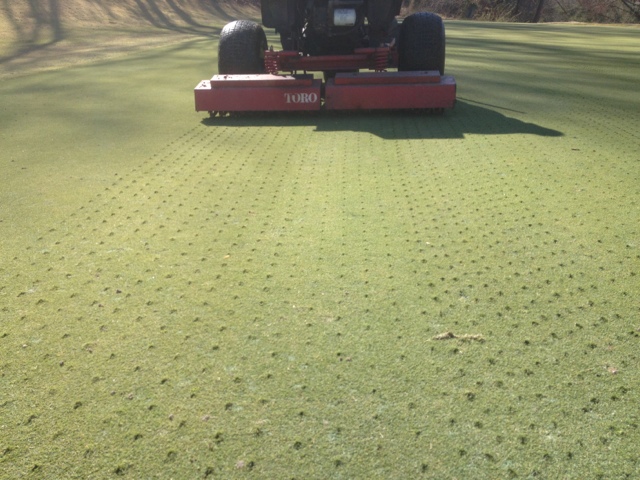


Once we finished, we put out our monthly application of wetting agents and a fungicide to mainly prevent zoysia patch, but it controls a broad spectrum of possible diseases. Notice the picture of #3 green the same day--can't tell we even did a thing to them, even ball roll wasn't affected.
Saturday, March 30, 2013
What's the difference?
So why and what is wrong with this picture? Answer is to come later!
Answer: pre-emergent herbicides were applied to the left. This shows just how important they really are!

Answer: pre-emergent herbicides were applied to the left. This shows just how important they really are!
# 3 walkway update
#3 is finished! I couldn't have asked the guys to do a better job! It was a huge task, but hopefully you seniors and ladies will enjoy it much better than the dirt trail!


Thursday, March 28, 2013
Burried in the Sand
See the images below for our latest project on 6. This is one of those "hidden gems" on the course that went away along the years. It adds so much character to number 6. A clean hill side, along with the two original bunkers that were there allow this hole to offer so much more aesthetically appealing. Holes 6,7, and 8/17 have been the focus of this winter's projects along with our walkways. I hope you are enjoying each of those, especially the one on number 3. Pictures of it are soon to be added! Enjoy the early works of number 6 and I will update you with many more pictures as this project is only half finished, even though both bunkers are fully "clean" again! There are more to come to help this hole become a stunning signature par 3!


They turned over the sand in the intire bunker in order to bring back the fresh white sand! All the crew has done an awesome job for me and we continue to do new things to enhance your golfing experience.

First phase is completed, now onto getting depths, and cleaning up and enhancing the surrounds of the bunkers. Stay tuned for more updates and enjoy!
What's in The Bag?
Well it has been way too long ago since I have last posted. Life got a little busy there for a few days/weeks. Fertilization numbers have driven me to the point of insanity! Pricing, analysis, timing, how long each product lasts, and the list goes on and on. I begin with this, because I really want to educate you, the golfer on what really each number in the analysis means, and why we need each one and just a few thoughts that go into the fertilization of your golf course. Just like our bodies need a certain percentage of carbohydrates, proteins, and fats, so do plants, just in the form of Nitrogen, Phosphorous, and Potassium (or the big 3). These are the macro nutrients that plants require. Just as our bodies need the big nutrients, their are also hundreds of other vitamins and minerals our bodies need. Plants are the same. This is why it is very important to know the type of grass you have and requirements that each grass takes at a certain time of the year. It would not be wise for me to fertilize our fairways and tees in December. Why? Because the plant is not actively growing and taking in food. It would be wise though to fertilizer Fescue in December, to keep it growing through the winter months. Now that we have that out of the way. How do you know what you need? Nitrogen, which is the most important for growth (foliage and above ground growth). So you have Ammonical Nitrogen, Urea, Nitrate, Insoluble, water soluble and the list continues of all the different forms of Nitrogen available and benefits of using a balanced approach. Our second number phosphorus helps root formation. Contrary to belief, phosphorous isn't a bad thing--only if it is done improperly, like most things in life. Turf must have it to form roots and better anchor itself and take up water and other nutrients in the soil. Lastly, we get to Potassium. When you think of potassium in humans, we think bananas and cramp preventives. This is similar in turf. It is the stress guard for plants. Stress from disease, insects, heat, and cold. It is important to keep all of these in perspective. To view more on this, visit a great website that NC STATE updates regularly http://www.turffiles.ncsu.edu/Keywords/nitrogen.aspx. Now the tricky part for me is getting something that is going to give golfers the best possible playing conditions. What is acceptable in the rough is not in the fairways, or greens, or tees. Each area has its own uniqueness about it, and when choosing fertilizer, its not just, oh lets go throw some fertilizer out and watch it grow. If you want the most consistent playing conditions for golfers it is imperative that we uses a slow release fertilizer that will release only a minimal amount each week. The ones I am looking at are to get us 4 months of a slow feed. This will minimize the effects of spikes in growth and baling hay in our fairways and rough! With all of this said, it is just a quick rant, while maybe educating you minimally, that I honestly am analyzing fertilizers way more than I probably should, but I just want to put out a product that will give me the best product available--all the while keeping prices in mind. I feel that the products I will go into detail throughout the year that we are applying at the time, are going to give us better results as we go throughout the summer. I want to do some areas that will maybe give me some answers--there is nothing like in field research side by side. If you can't tell a difference in roots, density, and blades, then really are they much different of a product? Only time will tell and I plan to find out!
Subscribe to:
Posts (Atom)